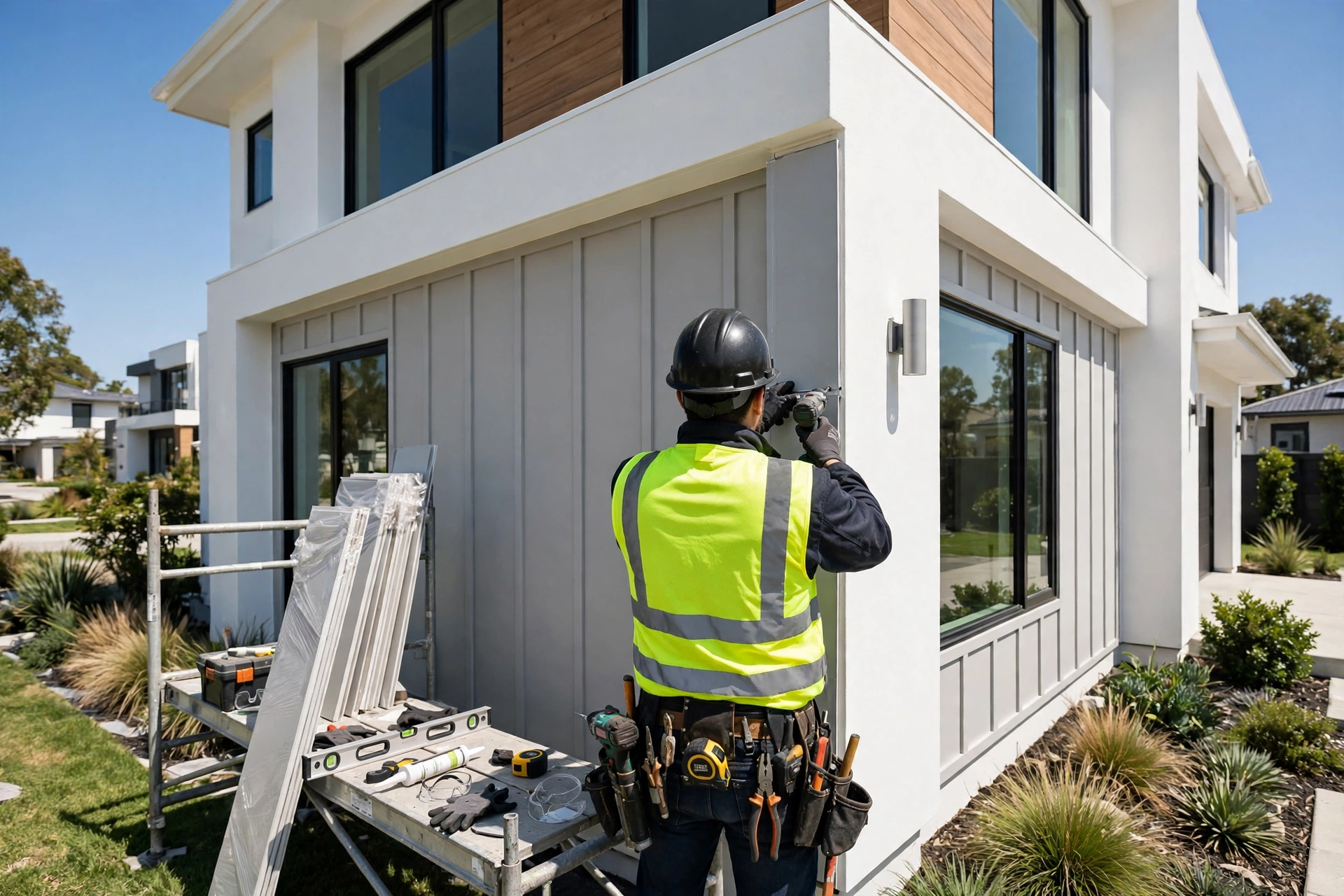
Siding is the outer skin of a home: it keeps weather out and protects the structure underneath. When siding is cracked, warped, or letting water in, the problem is rarely only cosmetic — good siding work starts with what is underneath, then installs a weather barrier, flashing, and siding system that sheds water properly.
Service
Siding Installation
Location
Arizona
Areas covered
10 cities
Coverage
By ZIP — call to check yours
Key facts for Arizona: 4 service options explained on this site, 4 process steps, 10 questions answered below. Prices are given as a written scope for your exact situation, not as a fixed price on this page.
📍10Cities covered
🔧4Service options explained
❓10Questions answered below
📞Call NowTo call (555) 010-1234
Our services
What we help with in Arizona
Each option below is explained in plain language — what it covers, when it is the right choice, and what to ask about before work starts.
Diagnosis first — the cause is checked before parts are replaced.
Signs your siding needs attention
✓Boards are cracked, warped, buckled, or pulling away from the wall.
✓Paint is peeling, blistering, or failing repeatedly in the same places.
✓You can see gaps, soft spots, or signs of water getting behind the siding.
✓Energy bills have risen and draughts are noticeable near exterior walls.
✓Mould, rot, or insect damage is visible on or behind the siding.
How it works
How siding work is done
Illustrative photo — siding installation work, not a specific customer job.
1
1. Inspect underneath
Old siding is checked and, where needed, removed so the wall, sheathing, and weather barrier underneath can be assessed.
Step 1 of 4
2
2. Repair and prepare
Damaged sheathing or flashing is repaired first. New siding over a bad base only hides the problem.
Step 2 of 4
3
3. Install the system
Weather barrier, flashing, and siding are installed in order, with proper overlaps so water drains out, not in.
Step 3 of 4
4
4. Finish and seal
Trims, corners, and penetrations around windows, doors, and vents are finished and sealed, then checked.
Step 4 of 4
Why call
A better way to get siding installation help
Illustrative photo — siding installation work, not a specific customer job.
✓
Explained before it is fixed
You hear what is wrong, what the options are, and what it costs before anyone starts.
$
Priced before work starts
A clear, written scope — not a vague estimate that grows as the job goes on.
📍
Local to Arizona
Service areas, neighbourhoods, and local conditions are covered on this site, not generic advice.
📞
One call to start
Describe the problem and where you are, and get connected to help for your area.
Illustrative photo — siding installation work, not a specific customer job.
What moves the price
$The siding material — vinyl, fibre cement, wood, and metal differ sharply in cost and lifespan.
$The size of the home and how many storeys or complex corners it has.
$How much old siding and damaged sheathing has to be removed and repaired.
$Trim, soffit, fascia, and window or door flashing work included in the job.
$Access, scaffolding needs, and local weather conditions during installation.
Illustrative photo — siding installation work, not a specific customer job.
What to do first
!Look for soft spots, gaps, and water stains — especially under windows and near the ground.
!Do not paint over damaged siding to hide it; that traps moisture and makes repairs bigger later.
!Ask what material is being proposed and why it suits your climate and your home.
!Ask for a written scope that names the weather barrier and flashing work, not just the siding boards.
In-depth guide
Siding Installation in Arizona: the full guide, in plain language
Illustrative photo — siding installation work, not a specific customer job.
Siding is often treated as a cosmetic choice, but its real job is protection. It is the outer skin that keeps rain, wind, and pests away from the structure underneath, and when it fails, the damage is rarely limited to the outside of the house. Water that gets behind cracked, warped, or loose boards can rot sheathing, damage insulation, and create conditions for mould inside the wall, long before anything is visible from the street. That is why siding work has to start with what is underneath, not with the colour or profile of the new boards.
Climate matters more than most homeowners expect, and it is different in every part of the country. Hot, sunny climates punish siding with expansion, fading, and heat stress. Cold climates punish it with freeze and thaw, ice, and moisture trapped in joints. Humid climates punish it with mould and rot where water lingers. Coastal air, hail, and wind-driven rain each add their own stresses. A material that performs well in one climate can fail early in another, which is why a siding recommendation should always be tied to local conditions, the orientation of each wall, and the condition of the existing weather barrier and flashing, rather than offered as a single default for every home.
Installation quality matters at least as much as material choice, and it is the part of the job that is hardest to see once the work is finished. Proper overlaps, flashing around windows and doors, sealed penetrations for vents and fixtures, and a continuous weather barrier are what make a siding system shed water instead of trapping it. A job that looks neat from the pavement but has gaps behind trims or missing flashing will fail from the inside out. Asking for a written scope that names the weather barrier, flashing, trim, and soffit work — not just the siding boards — is the simplest way to tell whether a proposal is complete.
Service options, explained in detail
Vinyl siding installation in Arizona
When you need vinyl siding installation in Arizona, the first question is not which product or package looks best in a brochure. It is what problem you are actually trying to solve, how urgent it is, and what a good outcome looks like in your home or building. Siding Installation work of this kind varies more than most people expect from one property to the next, because age, construction, previous work, and local conditions all change what is involved. A clear scope should therefore name the work itself, the materials or parts involved, what is included and what is not, and how the result will be checked before the job is signed off. If a proposal cannot explain those points in plain language, it is not yet ready to approve, however attractive the headline price may look. In Arizona, local conditions also matter: the climate, the age of the housing stock, and the way homes in this area were built all affect which approach is most durable, and a local conversation about those factors is worth more than a generic national guide.
Before you commit, ask how long the work is expected to take, what disruption to expect, what decisions you will need to make along the way, and what happens if something unexpected is found once work starts. Those questions are not difficult, and a professional provider should welcome them. They are also the questions that prevent the most common disappointments: work that starts without a clear plan, costs that grow because the scope was vague, and finishes that look good on day one but do not hold up. For vinyl siding installation in particular, the difference between a good result and a mediocre one is usually in the preparation and the checking at the end, not in the most visible part of the job, so give those stages the attention they deserve.
Fibre cement siding in Arizona
When you need fibre cement siding in Arizona, the first question is not which product or package looks best in a brochure. It is what problem you are actually trying to solve, how urgent it is, and what a good outcome looks like in your home or building. Siding Installation work of this kind varies more than most people expect from one property to the next, because age, construction, previous work, and local conditions all change what is involved. A clear scope should therefore name the work itself, the materials or parts involved, what is included and what is not, and how the result will be checked before the job is signed off. If a proposal cannot explain those points in plain language, it is not yet ready to approve, however attractive the headline price may look. In Arizona, local conditions also matter: the climate, the age of the housing stock, and the way homes in this area were built all affect which approach is most durable, and a local conversation about those factors is worth more than a generic national guide.
Before you commit, ask how long the work is expected to take, what disruption to expect, what decisions you will need to make along the way, and what happens if something unexpected is found once work starts. Those questions are not difficult, and a professional provider should welcome them. They are also the questions that prevent the most common disappointments: work that starts without a clear plan, costs that grow because the scope was vague, and finishes that look good on day one but do not hold up. For fibre cement siding in particular, the difference between a good result and a mediocre one is usually in the preparation and the checking at the end, not in the most visible part of the job, so give those stages the attention they deserve.
Siding repair and partial replacement in Arizona
When you need siding repair and partial replacement in Arizona, the first question is not which product or package looks best in a brochure. It is what problem you are actually trying to solve, how urgent it is, and what a good outcome looks like in your home or building. Siding Installation work of this kind varies more than most people expect from one property to the next, because age, construction, previous work, and local conditions all change what is involved. A clear scope should therefore name the work itself, the materials or parts involved, what is included and what is not, and how the result will be checked before the job is signed off. If a proposal cannot explain those points in plain language, it is not yet ready to approve, however attractive the headline price may look. In Arizona, local conditions also matter: the climate, the age of the housing stock, and the way homes in this area were built all affect which approach is most durable, and a local conversation about those factors is worth more than a generic national guide.
Before you commit, ask how long the work is expected to take, what disruption to expect, what decisions you will need to make along the way, and what happens if something unexpected is found once work starts. Those questions are not difficult, and a professional provider should welcome them. They are also the questions that prevent the most common disappointments: work that starts without a clear plan, costs that grow because the scope was vague, and finishes that look good on day one but do not hold up. For siding repair and partial replacement in particular, the difference between a good result and a mediocre one is usually in the preparation and the checking at the end, not in the most visible part of the job, so give those stages the attention they deserve.
Soffit, fascia, and trim work in Arizona
When you need soffit, fascia, and trim work in Arizona, the first question is not which product or package looks best in a brochure. It is what problem you are actually trying to solve, how urgent it is, and what a good outcome looks like in your home or building. Siding Installation work of this kind varies more than most people expect from one property to the next, because age, construction, previous work, and local conditions all change what is involved. A clear scope should therefore name the work itself, the materials or parts involved, what is included and what is not, and how the result will be checked before the job is signed off. If a proposal cannot explain those points in plain language, it is not yet ready to approve, however attractive the headline price may look. In Arizona, local conditions also matter: the climate, the age of the housing stock, and the way homes in this area were built all affect which approach is most durable, and a local conversation about those factors is worth more than a generic national guide.
Before you commit, ask how long the work is expected to take, what disruption to expect, what decisions you will need to make along the way, and what happens if something unexpected is found once work starts. Those questions are not difficult, and a professional provider should welcome them. They are also the questions that prevent the most common disappointments: work that starts without a clear plan, costs that grow because the scope was vague, and finishes that look good on day one but do not hold up. For soffit, fascia, and trim work in particular, the difference between a good result and a mediocre one is usually in the preparation and the checking at the end, not in the most visible part of the job, so give those stages the attention they deserve.
Warning signs, in detail
Boards are cracked, warped, buckled, or pulling away from the wall.
This sign matters because it is often the earliest visible clue that something has changed in the home or building, and early clues are cheaper and easier to act on than later damage. Do not ignore it, and do not assume it will resolve on its own. Note when you first noticed it, whether it is getting worse, and whether it affects one room or several, because that information helps a professional assess urgency and likely cause on the first call. In Arizona, where siding installation issues are commonly linked to local housing age and climate, a sign like this should prompt a conversation, not a wait-and-see approach that allows a small problem to become a larger repair.
Paint is peeling, blistering, or failing repeatedly in the same places.
This sign matters because it is often the earliest visible clue that something has changed in the home or building, and early clues are cheaper and easier to act on than later damage. Do not ignore it, and do not assume it will resolve on its own. Note when you first noticed it, whether it is getting worse, and whether it affects one room or several, because that information helps a professional assess urgency and likely cause on the first call. In Arizona, where siding installation issues are commonly linked to local housing age and climate, a sign like this should prompt a conversation, not a wait-and-see approach that allows a small problem to become a larger repair.
You can see gaps, soft spots, or signs of water getting behind the siding.
This sign matters because it is often the earliest visible clue that something has changed in the home or building, and early clues are cheaper and easier to act on than later damage. Do not ignore it, and do not assume it will resolve on its own. Note when you first noticed it, whether it is getting worse, and whether it affects one room or several, because that information helps a professional assess urgency and likely cause on the first call. In Arizona, where siding installation issues are commonly linked to local housing age and climate, a sign like this should prompt a conversation, not a wait-and-see approach that allows a small problem to become a larger repair.
Energy bills have risen and draughts are noticeable near exterior walls.
This sign matters because it is often the earliest visible clue that something has changed in the home or building, and early clues are cheaper and easier to act on than later damage. Do not ignore it, and do not assume it will resolve on its own. Note when you first noticed it, whether it is getting worse, and whether it affects one room or several, because that information helps a professional assess urgency and likely cause on the first call. In Arizona, where siding installation issues are commonly linked to local housing age and climate, a sign like this should prompt a conversation, not a wait-and-see approach that allows a small problem to become a larger repair.
Mould, rot, or insect damage is visible on or behind the siding.
This sign matters because it is often the earliest visible clue that something has changed in the home or building, and early clues are cheaper and easier to act on than later damage. Do not ignore it, and do not assume it will resolve on its own. Note when you first noticed it, whether it is getting worse, and whether it affects one room or several, because that information helps a professional assess urgency and likely cause on the first call. In Arizona, where siding installation issues are commonly linked to local housing age and climate, a sign like this should prompt a conversation, not a wait-and-see approach that allows a small problem to become a larger repair.
The process, step by step, in detail
1. Inspect underneath
Old siding is checked and, where needed, removed so the wall, sheathing, and weather barrier underneath can be assessed. In practice, this stage is where a good job is won or lost, because it is the point at which assumptions are checked against reality. A professional will explain what they found at this stage, what it means for the rest of the job, and whether the original plan still holds or needs to change. If the plan does change, the change should be explained and agreed before work continues, not discovered later in an invoice. For siding installation in Arizona, this stage also has to account for local access, local conditions, and the specific construction of the property, which is why a generic timeline without a property-specific check is rarely reliable.
2. Repair and prepare
Damaged sheathing or flashing is repaired first. New siding over a bad base only hides the problem. In practice, this stage is where a good job is won or lost, because it is the point at which assumptions are checked against reality. A professional will explain what they found at this stage, what it means for the rest of the job, and whether the original plan still holds or needs to change. If the plan does change, the change should be explained and agreed before work continues, not discovered later in an invoice. For siding installation in Arizona, this stage also has to account for local access, local conditions, and the specific construction of the property, which is why a generic timeline without a property-specific check is rarely reliable.
3. Install the system
Weather barrier, flashing, and siding are installed in order, with proper overlaps so water drains out, not in. In practice, this stage is where a good job is won or lost, because it is the point at which assumptions are checked against reality. A professional will explain what they found at this stage, what it means for the rest of the job, and whether the original plan still holds or needs to change. If the plan does change, the change should be explained and agreed before work continues, not discovered later in an invoice. For siding installation in Arizona, this stage also has to account for local access, local conditions, and the specific construction of the property, which is why a generic timeline without a property-specific check is rarely reliable.
4. Finish and seal
Trims, corners, and penetrations around windows, doors, and vents are finished and sealed, then checked. In practice, this stage is where a good job is won or lost, because it is the point at which assumptions are checked against reality. A professional will explain what they found at this stage, what it means for the rest of the job, and whether the original plan still holds or needs to change. If the plan does change, the change should be explained and agreed before work continues, not discovered later in an invoice. For siding installation in Arizona, this stage also has to account for local access, local conditions, and the specific construction of the property, which is why a generic timeline without a property-specific check is rarely reliable.
Pricing, in detail
The siding material — vinyl, fibre cement, wood, and metal differ sharply in cost and lifespan.
This factor affects price because it changes the amount of work, the materials, or the time required, and it is one of the reasons why two apparently similar jobs can be priced very differently. A written quote should show how this factor has been accounted for, rather than hiding it inside a single lump sum. If you are comparing quotes for siding installation in Arizona, compare them factor by factor, not just by total: a lower total that omits a major factor is not a saving, it is a cost that will appear later. Ask for the breakdown, ask what is excluded, and ask what would change the price if conditions on site differ from what was assumed.
The size of the home and how many storeys or complex corners it has.
This factor affects price because it changes the amount of work, the materials, or the time required, and it is one of the reasons why two apparently similar jobs can be priced very differently. A written quote should show how this factor has been accounted for, rather than hiding it inside a single lump sum. If you are comparing quotes for siding installation in Arizona, compare them factor by factor, not just by total: a lower total that omits a major factor is not a saving, it is a cost that will appear later. Ask for the breakdown, ask what is excluded, and ask what would change the price if conditions on site differ from what was assumed.
How much old siding and damaged sheathing has to be removed and repaired.
This factor affects price because it changes the amount of work, the materials, or the time required, and it is one of the reasons why two apparently similar jobs can be priced very differently. A written quote should show how this factor has been accounted for, rather than hiding it inside a single lump sum. If you are comparing quotes for siding installation in Arizona, compare them factor by factor, not just by total: a lower total that omits a major factor is not a saving, it is a cost that will appear later. Ask for the breakdown, ask what is excluded, and ask what would change the price if conditions on site differ from what was assumed.
Trim, soffit, fascia, and window or door flashing work included in the job.
This factor affects price because it changes the amount of work, the materials, or the time required, and it is one of the reasons why two apparently similar jobs can be priced very differently. A written quote should show how this factor has been accounted for, rather than hiding it inside a single lump sum. If you are comparing quotes for siding installation in Arizona, compare them factor by factor, not just by total: a lower total that omits a major factor is not a saving, it is a cost that will appear later. Ask for the breakdown, ask what is excluded, and ask what would change the price if conditions on site differ from what was assumed.
Access, scaffolding needs, and local weather conditions during installation.
This factor affects price because it changes the amount of work, the materials, or the time required, and it is one of the reasons why two apparently similar jobs can be priced very differently. A written quote should show how this factor has been accounted for, rather than hiding it inside a single lump sum. If you are comparing quotes for siding installation in Arizona, compare them factor by factor, not just by total: a lower total that omits a major factor is not a saving, it is a cost that will appear later. Ask for the breakdown, ask what is excluded, and ask what would change the price if conditions on site differ from what was assumed.
Material comparison: vinyl, fibre cement, wood, and metal
Illustrative photo — siding installation work, not a specific customer job.
Choosing a siding material without comparing the trade-offs is how homeowners end up with a product that looks right but performs badly in their climate. Vinyl is lower cost, low maintenance, and widely available, but it can warp in extreme heat and crack in severe cold, and colour choices are limited. Fibre cement is durable, fire-resistant, and holds paint well, but it is heavier, more expensive to install, and needs proper cutting and sealing. Wood looks traditional and can be beautiful, but it needs regular painting or staining and is more vulnerable to moisture and insects. Metal is strong and low maintenance, but it can dent and, without a proper thermal break, it can conduct heat and cold. The right answer depends on climate, budget, home style, and maintenance appetite — not on a single product claim.
•Vinyl: lower cost, low maintenance, watch heat and cold limits.
•Fibre cement: durable and fire-resistant, heavier and costlier to install.
•Wood: traditional look, needs regular upkeep and moisture protection.
•Metal: strong and low maintenance, check denting and thermal performance.
Weather barriers, flashing, and why the hidden layers matter
Illustrative photo — siding installation work, not a specific customer job.
The layers underneath siding are invisible once the job is finished, which is exactly why they matter. A continuous weather barrier, properly lapped and sealed, is what keeps wind-driven rain from reaching sheathing. Flashing around windows, doors, corners, and penetrations is what directs water out instead of letting it sit in joints. If those layers are missing, damaged, or installed in the wrong order, even excellent siding boards will fail from behind. A written scope that names the weather barrier product, the flashing locations, and how penetrations will be sealed is the clearest sign that a proposal has been thought through as a system, not just as a surface.
Insulation, energy, and what siding can and cannot do
Illustrative photo — siding installation work, not a specific customer job.
Siding can contribute to energy performance, but it should not be sold as a substitute for insulation and air sealing. Insulated siding and a proper weather barrier can reduce draughts and improve comfort, especially on older homes with little wall insulation, but the biggest energy gains usually come from a combination: air sealing, insulation where it is missing, and a siding system that is properly installed and sealed. If a proposal promises dramatic bill reductions from siding alone, ask for the calculation behind that claim, and ask what air sealing and insulation work is included. A proposal that is honest about limits is more trustworthy than one that promises everything.
Maintenance by material: what to check each year
Illustrative photo — siding installation work, not a specific customer job.
Every siding material needs some maintenance, and the difference is in kind, not in whether maintenance is needed at all. Vinyl benefits from gentle washing and a check for cracked or loose boards after storms. Fibre cement needs paint and caulk checks, especially at joints and penetrations. Wood needs the most attention: paint or stain condition, moisture damage, and insect signs. Metal needs dent and finish checks, and a check that fasteners have not loosened. An annual walk around the house, looking closely at the bottom courses, around windows and doors, and where siding meets the ground or roof, will catch most problems while they are still small and cheap to fix.
Service areas
Cities we cover in Arizona
Click a city for siding installation help in that city, including its neighbourhoods.
Coverage honesty: LeadSmart coverage is sold by ZIP code, and live buyer coverage in a specific ZIP can change over time. The cities and neighbourhoods listed here are major service-area guides for Arizona — they are real places, and they are not a guarantee that a buyer is available in every ZIP on any given day. No ZIP list is invented on this page, and no street address is claimed. If you are unsure whether help is available for your exact area, call and ask — that is the fastest way to get an accurate answer for your ZIP.
Illustrative photo — siding installation work, not a specific customer job.
Short explainer video — illustrative footage of this kind of work, not a specific customer job.
Illustrative photo — siding installation work, not a specific customer job.
Gallery
Browse siding installation work in Arizona
Browse the gallery to get a sense of the kinds of siding installation work covered on this site. Images are illustrative photos of this kind of work, not photos of a specific customer job.
Illustrative photo — siding installation work, not a specific customer job.Illustrative photo — siding installation work, not a specific customer job.Illustrative photo — siding installation work, not a specific customer job.Illustrative photo — siding installation work, not a specific customer job.Illustrative photo — siding installation work, not a specific customer job.Illustrative photo — siding installation work, not a specific customer job.Illustrative photo — siding installation work, not a specific customer job.Illustrative photo — siding installation work, not a specific customer job.
Questions, answered
Good to know before you call
Illustrative photo — siding installation work, not a specific customer job.
How long does siding last?⌄
It depends on the material and the climate. Vinyl commonly lasts decades with basic care; fibre cement and metal can last longer. Installation quality matters as much as the material.
Can you replace siding on one wall only?⌄
Yes, when the damage is limited to that wall. Matching colour and profile with older siding can be a challenge, so ask about matching before you commit.
Does new siding help with energy bills?⌄
It can help, especially when combined with a proper weather barrier and insulation. Siding alone is not a substitute for insulation or air sealing.
What is the best siding material?⌄
There is no single best answer. Vinyl is lower cost and low maintenance; fibre cement is more durable and fire-resistant; wood looks traditional but needs more upkeep. Climate and budget decide.
Will new siding change how my home looks?⌄
Yes — colour, profile, and trim change the whole street view. Ask to see samples on your home in daylight before choosing a colour.
How much does siding installation cost?⌄
There is no fixed price, because cost depends on material, home size and storeys, how much old siding and damaged sheathing must be removed, and trim and flashing work. A written scope naming the weather barrier and flashing is the only accurate price.
Is vinyl or fibre cement better for my climate?⌄
It depends on climate, budget, and maintenance. Vinyl is lower cost and low maintenance; fibre cement is more durable and more fire-resistant. Ask which suits your local weather and your home, not just which is cheapest.
Can siding be installed in cold weather?⌄
It depends on the material and the weather on the day. Some materials handle cold better than others, and installation quality can suffer in extreme conditions — ask what conditions your installer will and will not work in.
How do I know if water is getting behind my siding?⌄
Look for soft spots, gaps, water stains under windows and near the ground, and paint failing repeatedly in the same places. Water behind siding is the sign to act on, not just a cosmetic problem.
Does siding replacement require a permit?⌄
It depends on the work and your area. Full replacement and structural repair commonly need permits and inspections, while a small repair may not. Ask what applies in your area before work starts.